
A dull ache that seems to build rather than fade, gum that looks thinner over the surgical site, or tiny gritty grains on your tongue can quickly send you searching for signs of failed dental bone graft healing. You might be checking the area in the mirror each morning or wondering whether the swelling should have settled by now. Recovery after dental surgery rarely follows a neat timetable, so it can be hard to tell what is part of normal healing and what deserves a closer look.
A bone graft is often the first step in preparing the jaw for dental implants, and it can take months before the new bone is ready to hold an implant. Some changes are part of the body’s normal repair process, while others are worth having checked sooner. Knowing what to watch for during that time can help you act early if something changes.
Quick Overview
- A dental bone graft procedure aims to restore lost bone by adding bone or graft material to the jaw.
- It is often placed after a tooth extraction or in preparation for implant placement, and it may be planned when missing teeth have left the jaw too thin or too short.
- Most of the healing happens out of sight, as new bone slowly grows into the graft over several months.
- Smoking, gum health, blood sugar control and the size of the graft may all influence how well it heals.
- Pain that worsens, an opening in the gum or ongoing discharge are usually what prompt a closer assessment.
Below, we explain how a graft heals, which warning signs matter and what your dentist may look for at a review.
How Does a Dental Bone Graft Heal?
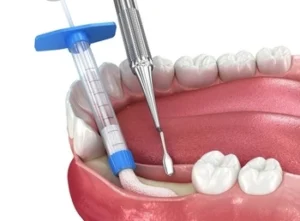 A dental bone graft acts as a scaffold. The graft material is placed against your existing bone. Over the following months, your body gradually grows new bone tissue into and around it. In most cases, the area heals for three to six months before an implant goes in, depending on the graft’s size and location.
The bone graft material may be your own bone, donor bone, animal-derived bone or a synthetic substitute. A thin membrane is sometimes placed over the top. It keeps the faster-growing gum tissue out of the space, so bone regeneration has room to take place underneath.
In the upper jaw, a graft may be placed beneath the floor of the sinus cavities to add height where bone is thin. Wherever it sits, the graft relies on blood flow from the surrounding bone and a closed, stable layer of gum over the top. Because most of the work happens below the surface, a graft site can look settled while bone healing is still under way.
What Does Normal Healing Look Like?
Bone grafting is a common procedure in implant dentistry, and some discomfort, bruising, swelling and minor inflammation are expected afterwards. Swelling of the jaw can last for one to two weeks, and it should ease gradually rather than build.
Like any medical procedure, dental bone graft surgery places stress on the soft tissues, and they need time to knit back together. Tenderness when you touch the area, mild stiffness when you open wide, and a gum line that looks slightly puffy for the first week or so can all be part of that process. The key pattern to look for is steady improvement. A graft that heals as expected tends to feel a little better each day, even if progress is slow.
Signs of Failed Dental Bone Graft to Watch For
The warning signs of a failing graft include pain that worsens after the first few days, swelling that grows instead of shrinking, pus or a bad taste, an opening in the gum over the graft site and graft material that keeps coming loose. Any of these deserves a prompt check.
- Persistent pain or severe pain. Discomfort that eases and then returns, or a throbbing ache that is stronger on day five than on day two, may point to infection under the gum.
- Swelling that increases. A cheek or jaw that becomes more swollen, firm or warm after it had started to settle can be a sign that bacteria have reached the graft.
- Discharge, a bad taste or an odour. Pus, a salty taste or bad breath that brushing does not shift can all be features of an infected surgical site.
- Persistent bleeding. Excessive bleeding that does not settle, or bleeding that restarts days after surgery, needs attention.
- An opening in the gum. If the edges of the incision pull apart, you may see a white or grey patch of membrane or graft material. In one 2025 study, half of wound openings appeared early, within the first two weeks. The authors noted that an early opening that becomes infected can put the graft at risk.
- Loose graft particles. A steady loss of gritty material from the site may suggest the graft is not staying in place.
- Gum recession over the area. If the gum shrinks back, or the ridge looks flatter than it did after surgery, some of the bone volume may have been lost.
Some patients describe these changes as bone graft rejection. In practice, your dentist will usually look at more practical causes first, such as infection, an open wound or poor blood supply to the area. If you notice any of these signs of a failed graft, call us so we can examine the site, rather than waiting for your next scheduled review.
What Raises the Risk of Dental Bone Graft Failure?
Graft failure usually comes down to a mix of factors rather than a single cause. Common risk factors include smoking, active gum disease, blood sugar control and the size and shape of the graft. Each can influence whether the graft is healing properly.
Smoking. Smoking reduces the oxygen that reaches healing tissue. Australian guidance notes that smoking slows healing after extractions, and it is also linked with implant failure. For this reason, your dentist may talk with you about stopping before and after surgery.
Gum disease and oral hygiene. Periodontal disease is a common reason for bone loss and tooth loss in the first place. Bacteria from advanced gum disease or poor oral hygiene can also reach a fresh graft, so active gum problems are generally treated before a graft is placed.
Diabetes. Evidence on this question is limited, but one review found similar bone gain with controlled diabetes when compared with patients without diabetes. The authors could not draw the same conclusion for poorly controlled diabetes, which is why blood sugar levels are often discussed before surgery.
Graft size, shape and location. Building bone upward by a large amount, or shaping a graft beyond the level of the neighbouring bone, may place more tension on the gum that covers it. In one study, over-built grafts had more complications than grafts that stayed within the natural contour of the jaw, and the same was true of taller vertical builds. Wound openings have also been reported more often in the upper jaw than in the lower jaw.
How Is a Failing Graft Assessed?
Your dentist will usually examine the site, ask how your symptoms have changed since surgery and take an X-ray or a 3D scan. Imaging shows whether bone growth is under way and whether the graft has kept its shape.
During the examination, your dentist may check the colour and thickness of the gum, look for an opening or discharge and gently test whether the graft feels firm. A standard X-ray gives a useful first view, while a 3D cone beam scan can measure the height and width of the ridge more precisely.
The findings help separate a minor healing problem from true graft failure. Part of a graft may be lost while the rest joins the natural bone, and that outcome is managed differently from a graft that has failed completely. Your dentist will also consider whether the remaining bone volume is still enough for the implant therapy you had planned.
How Can You Protect a Healing Bone Graft?
Following your aftercare instructions closely gives a graft a better chance to settle. Most of the steps are simple, and they focus on keeping pressure, bacteria and movement away from the site.
- Choose soft foods. For the first stage of healing, soft foods and chewing on the other side of your mouth can reduce pressure on the graft.
- Leave the site alone. Avoid prodding the area with your tongue or fingers, and resist pulling your lip back to look at it.
- Follow denture advice. If you wear a denture or a temporary tooth over the area, wear it only as instructed, since pressure from an appliance can disturb the graft.
- Take medicines as prescribed. Finish any antibiotics you are given, and use a prescribed mouth rinse exactly as directed.
- Keep every review. Follow-up visits allow early changes to be picked up while they are still easier to manage.
Good oral hygiene across the rest of your mouth also supports your oral health while the graft heals. It can lower the risk of oral health complications at the surgical site.
 When to Have Your Bone Graft Checked
 When to Have Your Bone Graft Checked
A small change at a graft site can be the first sign that bone healing has stalled, and early attention may give more options for saving the graft. At Balmoral Dental Centre, we perform bone grafting and implant surgery in-house. Our 3D cone beam scanner lets us see how a graft is joining your natural bone. If your recovery doesn’t feel right, we can examine the site, review your scan and talk you through the next step. To arrange an assessment, please call us on (07) 3113 9789.
Frequently Asked Questions
Do signs of failed dental bone graft always appear in the first few weeks?
Not always, as some problems show up months later. In one recent study of gum openings over grafts, close to a third of openings appeared late, more than nine weeks after surgery. A graft can also lose volume without causing pain, which is why imaging at review appointments matters.
Can a failed dental bone graft heal on its own?
A small opening in the gum can sometimes close again with careful cleaning, an antiseptic rinse and close monitoring, without removing the graft. A graft that is infected or has lost most of its volume may not recover by itself. In that situation, your dentist may need to clean the area and remove loose material, then allow the site to heal before planning further treatment.
Can I still get dental implants after a failed bone graft?
In many cases, yes. When a graft fails and there is not enough bone left, additional grafting procedures may be planned once the site has healed. A repeat graft can allow implant placement to go ahead, rather than needing to switch to other restorative treatments. The timing of the implant depends on how well the site heals and how much bone has been rebuilt.
When is a problem after a bone graft an emergency?
Facial swelling that makes it hard to breathe needs urgent care, as does bleeding from the mouth that will not stop. If swelling is affecting your breathing, call triple zero (000) straight away. Severe pain that keeps you awake at night warrants a same-day call to us.
Can I brush my teeth after a dental bone graft?
Yes. Brush your other teeth as usual with a soft brush, but avoid scrubbing the surgical site until you are told it is safe to do so. Your dentist will let you know when the area can be cleaned directly, which usually depends on how well the gum has closed.
Any surgical or invasive procedure carries risks. Before proceeding, you should seek a second opinion from an appropriately qualified health practitioner.
References
Kaya S, Barcellos BM, Fan S, Azaripour A, Walter C, Hartmann A, Sagheb K. Risk factors for dehiscence in alveolar ridge augmentation using patient-specific titanium mesh: a retrospective analysis. 2025. https://pmc.ncbi.nlm.nih.gov/articles/PMC12141700 (publisher version: https://link.springer.com/article/10.1186/s40729-025-00623-9)
SA Dental. Smoking. https://www.dental.sa.gov.au/advice/smoking
Oliveira LM, Zanatta FB, Antoniazzi RP, Miguez PA. Does diabetes mellitus affect guided bone regeneration outcomes in individuals undergoing dental implants? A systematic review and meta-analysis. 2024. https://www.frontiersin.org/journals/dental-medicine/articles/10.3389/fdmed.2024.1352763/full
Kloss FR, Kämmerer PW, Kloss-Brandstätter A. Risk factors for complications following staged alveolar ridge augmentation and dental implantation: a retrospective evaluation of 151 cases with allogeneic and 70 cases with autogenous bone blocks. 2023. https://www.mdpi.com/2077-0383/12/1/6
Guy’s and St Thomas’ NHS Foundation Trust. Bone grafting for dental implants (last reviewed December 2024). https://www.guysandstthomas.nhs.uk/health-information/bone-grafting-dental-implants