

Sensitive teeth are one of the most common complaints we hear in dentistry.
Cold water, ice cream, breathing in cold air, brushing a particular spot, or even something sweet can cause that characteristic sudden, sharp pain that seems to shoot straight through the tooth.
And this isn’t just something my patients complain about. Tooth sensitivity is something that affects me personally as well.
I have a few areas of gum recession and exposed tooth surfaces that can become sensitive from time to time, so I know exactly what patients mean when they describe that horrible little “zing”.
Over the course of my career, my approach to treating sensitive teeth has actually changed quite a lot.
What I was originally taught at university, what I used during my first few years in dentistry, and what I use today are quite different.
And fortunately, our ability to treat sensitivity has improved considerably.
First, why are teeth sensitive?
Underneath the hard enamel covering the crown of your tooth is a layer called dentine.
Dentine is not a completely solid structure. Under a microscope, it contains thousands of tiny channels called dentinal tubules.
These microscopic tubules travel through the dentine towards the nerve inside the tooth.
Normally, enamel or gum tissue protects them.
The problem starts when dentine becomes exposed.
This commonly happens because of:
- gum recession
- aggressive tooth brushing
- acidic foods and drinks
- tooth erosion
- grinding and wear
- periodontal disease
- periodontal treatment
- natural changes to the gums over time
Once those microscopic tubules are open to the mouth, temperature changes, air and other stimuli can cause fluid within the tubules to move.
That movement stimulates nerve endings deeper inside the tooth and gives you that very characteristic short, sharp pain.
This is known as the hydrodynamic theory of dentine hypersensitivity, and it remains the most widely accepted explanation for why exposed dentine becomes sensitive.
If you understand that mechanism, most desensitising treatments suddenly make a lot more sense.
We are generally trying to do one of two things:
- Make the nerve less responsive.
or
- Block those microscopic dentinal tubules so fluid can’t move through them as easily.
Over the years, dentistry has tried many different ways of achieving those two goals.
Phase One: Toothpaste, Fluoride and Patience
When I was in dental school and in my first job, around 2010, our philosophy towards sensitivity was fairly conservative.
For the most part:
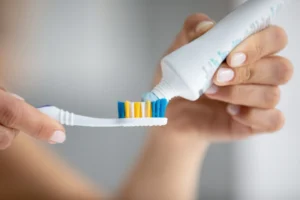 Sensitive teeth = sensitive toothpaste.
We used various fluoride treatments as well, but there was very much an expectation that patients would use a desensitising toothpaste for a few weeks and eventually things would improve.
Even the professional products available at the time followed a similar philosophy.
Around 2009-2010, Colgate was promoting Sensitive Pro-Relief Desensitising Polishing Paste for professional use. It contained 8% arginine and calcium carbonate and was designed to physically occlude exposed dentinal tubules.
I remember using these sorts of products and, to be fair, they absolutely helped some patients.
The problem was that the results could be extremely hit and miss.
Approach 1: Potassium Nitrate Toothpaste
This is probably the classic “sensitive toothpaste” approach.
Potassium-containing products work somewhat differently from treatments that physically block the tooth.
Rather than putting a permanent barrier over the exposed dentine, potassium ions are intended to reduce the excitability of the nerves associated with the tooth.
Essentially:
The stimulus can still occur, but the nerve becomes less responsive to it.
These products can work, particularly with consistent use, and desensitising toothpaste remains a sensible first-line treatment for many patients.
The disadvantage is that it isn’t necessarily immediate.
You need the patient to use the product consistently, often for several weeks, before deciding whether it has been successful.
Approach 2: Fluoride and Mineral Deposition
The other traditional approach is trying to block the dentinal tubules.
Fluoride-containing products, particularly certain formulations containing stannous fluoride, can encourage deposits to form over and within exposed dentinal tubules.
There are also products based on strontium salts, calcium compounds and other mineral technologies that work along similar principles.
If you can narrow or close those tubules, you reduce the movement of fluid through them and therefore reduce the stimulus reaching the nerve.
Again, this can work.
But there is a practical problem.
Whatever you deposit onto the tooth has to stay there.
For a patient with active erosion, a highly acidic diet, aggressive tooth brushing or significant mechanical wear, you can sometimes spend weeks gradually encouraging a microscopic mineral layer to develop while the patient is simultaneously removing it.
That was one of the frustrations I had with these treatments.
The science made sense.
The real-world results weren’t always as predictable.
Approach 3: Arginine and Calcium Carbonate
This was an interesting development and was the technology behind Colgate Sensitive Pro-Relief.
Rather than simply relying on fluoride, arginine and calcium carbonate help create a calcium-rich deposit that plugs exposed dentinal tubules.
Clinical and laboratory studies demonstrated significant tubule occlusion and reductions in sensitivity with this approach.
It was certainly an improvement in our ability to physically address the cause of sensitivity.
But again, we’re relying on a mineral deposit remaining attached to a surface sitting in one of the harshest environments in the human body.
Every day that surface is exposed to toothbrushes, food, acids, saliva and temperature changes.
For mild sensitivity, these products can be fantastic.
For more persistent sensitivity, I wanted something more predictable.
Phase Two: Discovering GLUMA
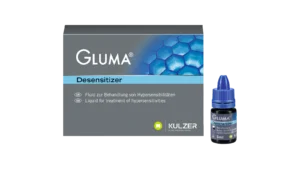
Later in my career, I worked for a dental specialist from Switzerland.
This was where I was introduced to GLUMA Desensitizer by Kulzer.
At the time, GLUMA felt like a fairly major step forward from simply giving someone sensitive toothpaste and hoping for the best.
GLUMA contains glutaraldehyde and HEMA.
Glutaraldehyde reacts with proteins within the dentinal fluid, causing those proteins to precipitate within the dentinal tubules.
That reduces the permeability of the dentine and restricts fluid movement through the tubules.
In simple terms:
Instead of waiting for toothpaste to gradually help, we could directly treat the exposed dentine and obstruct those tiny channels.
And it worked.
I used GLUMA for many years, and I still think it’s a clever product.
For a lot of patients, it produced a very obvious reduction in sensitivity.
But it wasn’t perfect.
Some patients responded beautifully.
Some responded only partially.
And occasionally I would treat an area, initially get a good result, and then find that the sensitivity returned.
There were practical disadvantages too.
Anyone who has worked with GLUMA knows that it tastes absolutely terrible if the patient gets any of it in their mouth.
Isolation therefore matters.
And while the application doesn’t sound particularly complicated on paper, doing it carefully across several sensitive cervical areas could take a surprising amount of clinical time.
It was better than what I’d been using previously.
I just still didn’t feel that treating dentine hypersensitivity was as predictable as I wanted it to be.
Phase Three: Shield Force Plus
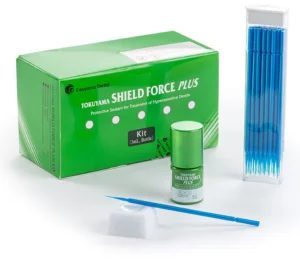
These days, my preferred product for significant dentine hypersensitivity is Tokuyama Shield Force Plus.
And this is where my approach changed again.
Shield Force Plus is not just another fluoride varnish or chemical desensitiser.
It is a light-cured, resin-based protective sealant specifically designed for hypersensitive dentine.
That distinction is important.
Instead of trying to make the nerve tolerate an open dentinal tubule, or depositing a relatively fragile mineral precipitate inside it, we are essentially sealing the exposed dentine with a very thin protective resin layer.
And for me, clinically, this has been a game changer.
How Shield Force Plus works
Tokuyama describes its mechanism as a double-block effect.
When Shield Force Plus is applied to exposed dentine, its functional acidic monomers interact with the mineral component of the tooth and penetrate into the exposed dentinal tubules.
The material is then carefully air-thinned and light cured.
The resin polymerises, producing both occlusion within the dentinal tubules and a thin, cured protective layer over the exposed dentine.
Studies examining the material microscopically have demonstrated substantial tubule occlusion, and resin penetration into the tubules has been reported to extend approximately 50 micrometres.
In very simple terms, imagine thousands of microscopic straws running through the tooth.
Older treatments might try to deposit something inside the opening of the straw.
Shield Force Plus effectively infiltrates those openings and then creates a cured resin shield over the top of them.
Once those tubules are sealed, fluid movement is dramatically reduced.
And because fluid movement is what triggers the sensitivity in the first place, patients can often notice an improvement immediately.
Why I’ve Become Such a Big Fan of It
There are a few reasons.
1. The results are immediate
This is probably the most satisfying part clinically.
We can identify a hypersensitive area with air or another appropriate stimulus before treatment.
Treat the dentine.
Light-cure it.
And test the area again.
Often the difference is dramatic.
For someone who has spent years avoiding cold water on one particular tooth, that immediate change can be quite surprising.
2. I find the results much more consistent
No desensitising treatment works perfectly in every situation.
There are also many causes of dental pain that can masquerade as sensitivity.
But when I have genuine exposed-dentine hypersensitivity, I find Shield Force Plus considerably more predictable than the treatments I relied upon earlier in my career.
That consistency is probably the main reason it has become my preferred treatment.
3. We’re creating a physical barrier
This is the biggest conceptual difference for me.
We aren’t simply asking a patient to brush with something for several weeks and hope enough material accumulates.
We’re creating a polymerised physical barrier over the exposed dentine.
Tokuyama specifically describes the cured layer as a durable coating that both seals the dentinal tubules and helps protect exposed cervical dentine from abrasion and erosion.
That makes a lot of sense to me clinically.
If the sensitive surface is already exposed and weakened, I’d much rather protect it than simply make it less painful.
4. It can reduce further wear and tear
This is an advantage that I think gets overlooked.
Patients with sensitivity frequently have exposed root surfaces due to recession, abrasion or erosion.
Those surfaces are no longer protected by thick enamel.
Exposed root dentine is considerably more vulnerable to continuing wear.
The cured Shield Force Plus layer provides some additional protection against abrasion and erosion, which is actually one of the manufacturer’s stated indications for the product.
So we’re not only trying to turn the sensitivity off.
We’re also placing a protective coating over the vulnerable surface responsible for it.
5. The application is relatively simple
The material is applied directly to the sensitive dentine, allowed to interact with the surface, carefully air dried and then light cured.
There is no complicated multi-bottle procedure.
There is no weeks-long waiting period before knowing whether we’ve achieved anything.
And compared with some of the products I’ve used previously, the patient experience is considerably nicer.
6. I find the effect lasts
This is another area where I’ve been impressed clinically.
In my own patients, I have often found the desensitising effect can hold up for a very long time, and in suitable cases I have seen areas remain comfortable for around two years before needing attention again.
That’s my clinical observation rather than a guarantee.
The material is still sitting in the mouth and will gradually be subjected to tooth brushing, acidic foods, grinding and normal wear. Tokuyama’s current instructions acknowledge this and state that, depending on a patient’s oral hygiene and wear, reapplication may sometimes be required considerably sooner.
But compared with repeatedly applying products and hoping enough remains inside the dentinal tubules, I have found the durability very impressive.
So Have Sensitive Toothpastes Become Obsolete?
Absolutely not.
I still recommend desensitising toothpaste.
If someone has mild, generalised sensitivity, particularly when multiple teeth are affected, using a good sensitive toothpaste is easy, inexpensive and non-invasive.
Products containing potassium salts, stannous fluoride, arginine/calcium carbonate and other tubule-occluding technologies all have a legitimate role in managing dentine hypersensitivity. Research also shows that different formulations perform differently and that there isn’t one toothpaste that is universally superior in every patient.
I generally think of treatment as a ladder.
Mild sensitivity
Start with identifying the cause, modifying brushing or dietary habits where necessary, and using an appropriate desensitising toothpaste.
Persistent sensitivity
Consider professional fluoride, mineralising or tubule-occluding treatment.
Significant localised sensitivity
A professionally applied resin-based dentine sealant such as Shield Force Plus can provide a much more direct physical solution.
Significant tooth surface loss
If a tooth has lost enough structure, simply desensitising it may no longer be appropriate. The area may need to be restored with composite resin, glass ionomer or another restorative material.
One Important Warning: Not Every Sensitive Tooth Is “Sensitivity”
This is probably the most important part of the entire article.
A tooth that hurts when you drink something cold does not automatically have dentine hypersensitivity.
Sensitivity can also be caused by:
- dental decay
- a cracked tooth
- a leaking or failing filling
- grinding or occlusal trauma
- inflammation of the dental pulp
- an infected tooth
- recently completed dental treatment
Classical dentine hypersensitivity is usually a short, sharp response to a stimulus that disappears quickly once the stimulus is removed.
A tooth that aches spontaneously, wakes you up at night, hurts to bite on, or continues aching long after something cold touches it needs to be investigated rather than simply covered in desensitiser.
Even Tokuyama’s instructions recommend reconsidering other sources of pain, including pulpal pathology or traumatic occlusion, when sensitivity persists despite appropriate treatment.
Dentistry Keeps Changing
One of the things I enjoy about dentistry is that very small improvements in materials can completely change how we manage an everyday problem.
When I started treating sensitive teeth, the answer was often:
“Use this toothpaste and let’s see how it feels in a few weeks.”
Then products such as GLUMA allowed us to treat the dentinal tubules much more directly.
Now resin-based desensitisers allow us to go another step further and actually place a thin, light-cured protective barrier over vulnerable dentine.
For me personally, Shield Force Plus has been one of those relatively simple products that has made a surprisingly large difference to my everyday dentistry.
It’s quick.
It’s conservative.
The results are usually immediate.
I find them considerably more consistent.
And rather than simply reducing the sensation of pain, we’re physically protecting the exposed tooth surface that is causing the problem.
As someone who treats sensitive teeth every week, and has sensitive teeth himself, that’s a solution I can appreciate.