

When a tooth is badly damaged or infected, there are generally two paths a dentist can take: treat it with a root canal or remove it entirely. Both options resolve the immediate problem of infection or decay, but they have very different implications for your oral health in the months and years that follow. Understanding what each involves can help you have a more informed conversation with your dentist.
The right answer depends on the condition of the tooth, how much healthy structure remains, and factors specific to your overall dental health. A closer look at root canal treatment and what each option involves is a practical starting point for this decision.
Quick Overview
- Root canal treatment removes infected pulp tissue from inside a tooth to save it, while extraction removes the entire tooth from the jaw.
- Either option may be appropriate depending on the state of the tooth, the extent of infection, and whether the remaining tooth structure is viable.
- Root canal aims to preserve the natural tooth; extraction eliminates the infection but creates a gap that may need to be addressed.
- How well each option serves you long-term depends on factors including crown placement after a root canal, bone health, and whether a missing tooth is replaced.
- A clinical assessment, including X-rays, is needed to determine which approach is appropriate for the specific tooth.
Keep reading to understand what each procedure involves, how dentists decide between them, and what happens after each option.
What Is Root Canal Treatment?
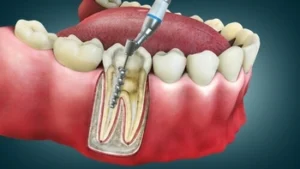
Root canal treatment addresses infection or damage that has reached the inner part of a tooth, known as the pulp. This soft tissue sits at the core of the tooth and houses the nerves and blood supply that kept it alive during development. Once the pulp becomes infected, typically through deep decay, a crack, or trauma, it can no longer recover on its own. Left alone, the infection tends to worsen and can spread beyond the tooth itself.
During the procedure, the dentist removes the infected pulp, cleans and shapes the root canals, and seals the space with a filling material. The tooth remains in the jaw and continues to function normally, though without the nerve tissue inside.
Root canal treatment can save a damaged or infected tooth rather than removing it. Most people experience some discomfort in the days following the procedure, but this typically settles quickly.
What Is Tooth Extraction?
 Tooth extraction means the complete removal of a tooth from its place in the jaw. The approach varies depending on the tooth’s position and condition. Teeth that sit fully in the mouth and are accessible can usually be removed in a straightforward procedure under local anaesthetic. Teeth that are impacted, fractured below the gum line, or otherwise hard to reach may require a more involved approach.
Extraction is generally considered when a tooth is too severely damaged or decayed to be saved, when infection has compromised too much of the supporting bone, or when a tooth is cracked in a way that makes root canal treatment impossible. It may also be the appropriate option for wisdom teeth causing problems.
Once a tooth is extracted, the gap it leaves can affect neighbouring teeth, bite function, and over time, the bone in that area.
How Dentists Decide Between the Two
The decision between root canal treatment and extraction is not a simple preference. It is a clinical judgement based on the state of the tooth, the amount of healthy structure remaining above and below the gum line, the condition of the surrounding bone, and the extent of the infection.
When a tooth still has a viable root, sufficient remaining structure to support a crown, and surrounding bone that is not severely compromised, root canal treatment is generally the preferred option. Preserving a natural tooth avoids the downstream consequences of a missing tooth: shifting of adjacent teeth, bone loss at the extraction site, and the cost and complexity of replacement.
When a tooth is beyond saving, either because the root is cracked vertically, the bone loss is too extensive, or the infection has made the tooth structurally unsalvageable, extraction becomes the appropriate choice. Attempting to save a tooth in this condition typically leads to repeated problems and eventual removal anyway.
What Happens After Each Option
After root canal treatment, the tooth needs to be restored. A dental crown is usually the recommended restoration because root-canal-treated teeth are more prone to fracture without one. Teeth that received a root canal but no crown were six times more likely to be removed than those that were crowned. Without a crown, the investment in saving the tooth is at higher risk.
After extraction, the options are to leave the gap or replace the tooth with a bridge, partial denture, or dental implant. Leaving the gap without replacement is not recommended for most teeth, as the consequences for neighbouring teeth and bone can compound over time.
Long-Term Considerations
Root canal treatment, when followed by appropriate restoration, has a high success rate. About 90 to 95 per cent of people who undergo root canal treatment can expect a functional tooth afterwards, provided they maintain good oral hygiene and attend regular dental check-ups.
Extraction resolves the immediate problem effectively, but the long-term implications depend on whether and how the tooth is replaced. Dental implants are generally considered the most effective replacement because they replace the root as well as the crown, which helps maintain bone stimulation in the jaw.
A Practical Starting Point
 Both root canal treatment and extraction are legitimate paths depending on the tooth’s condition and your broader oral health picture. The right choice is rarely obvious without a proper clinical assessment, and it is worth going into that conversation with a clear understanding of what each option involves and what comes after.
At Balmoral Dental Centre, we are open seven days a week, including weekends. Our dentists take time to assess the full picture before recommending a course of action, and we explain your options clearly before any treatment begins.
If you have a damaged or painful tooth and are unsure of the appropriate path forward, we welcome you to book an assessment.
Call us on (07) 3113 9789
Note: Any surgical or invasive procedure carries risks. Before proceeding, you should seek a second opinion from an appropriately qualified health practitioner.
Frequently Asked Questions
Can a tooth that needs a root canal be left untreated?
Leaving an infected tooth untreated is not a safe option. The infection inside the tooth will continue to develop, and the longer it is left, the more likely it is to spread to surrounding bone and soft tissue. In some cases, dental abscesses can become serious medical concerns if the infection spreads. The decision is not whether to treat the tooth but which treatment is appropriate.
What happens to the bone after a tooth is extracted?
When a tooth is removed, the jawbone in that area no longer receives stimulation from a root during chewing. Over time, the bone begins to resorb, gradually reducing in height and width. This process can affect the shape of the jaw, the fit of any neighbouring teeth, and the suitability of the site for an implant in the future. This is one of the reasons replacing an extracted tooth is generally recommended.
References
Healthdirect Australia. (2024). ‘Root Canal Treatment’. Healthdirect Australia. Canberra, ACT: Australian Government. https://www.healthdirect.gov.au/root-canal-treatment
Australian Dental Association. (n.d.). ‘Root Canal Treatment’. Teeth.org.au. Sydney, NSW: Australian Dental Association. https://teeth.org.au/root-canal-treatment
Better Health Channel. (n.d.). ‘Root Canal Treatment’. Better Health Channel. Melbourne, VIC: State Government of Victoria, Department of Health. https://www.betterhealth.vic.gov.au/health/conditionsandtreatments/root-canal-treatment